
Why We Use Paper Face for Our Glass Mosaic Tiles
Why we use Paper Face, and why we deliberately avoid mesh and glue-dot backing systems.
If you've shopped for glass mosaic tile before, you've probably noticed that not every sheet is put together the same way. Flip a mosaic sheet over and you'll usually find one of three backing methods: a fibreglass mesh glued to the back, a grid of plastic or polyurethane glue dots holding the pieces together, or a sheet of paper facing the front of the tiles instead. At Tiles of Ezra, we mount our glass mosaics face-down on paper, and we do it deliberately not because it's the cheapest or fastest option (it isn't), but because it's the only one of the three that doesn't compromise the thing that makes glass mosaic beautiful in the first place: the glass. We wanted to lay out—properly—what each system actually is, what it does to the tile once it's on the wall, and why paper face is the standard we hold ourselves to.
The three backing systems, briefly
Mesh-backed tile has each individual piece, or tessera, glued to a sheet of fibreglass mesh on the back of the tile, the side that goes against the wall. It's the most common backing in the broader tile industry because it's fast to manufacture and fast to install: press the sheet on, and you're already bonding tile to wall.
Glue-dot (or "dot-mounted") tile uses small dots of PVC or polyurethane adhesive, usually applied at the corners or edges of each piece on the back face, to hold the sheet together without a continuous mesh. It leaves more of the tile's back surface exposed than mesh does, and it's often marketed as the premium alternative to mesh for that reason.

Paper-faced tile is mounted the opposite way around: the individual pieces are held together by a sheet of paper glued to the front - the finished, visible side - while the entire back of every tile is left completely bare. The installer presses the sheet onto the wall paper-side-out, lets the adhesive cure, then wets the paper and peels it away to reveal the finished surface. That one difference - front-mounted versus back-mounted - is where all the practical advantages of paper face come from.

Nothing stands between the tile and the adhesive
Glass mosaic is only as strong as its bond to the wall or floor, and that bond depends on full, even contact between the back of the tile and the thin-set or adhesive beneath it. With mesh backing, the mesh itself sits between the tile and the substrate. It's a barrier, and no matter how thin it is, it reduces the surface area actually available for adhesive contact and can trap air pockets underneath individual pieces. Glue-dot systems are an improvement here - because the dots and glue connectors are small and sparse, they typically leave somewhere in the range of 90% of the tile's back surface free for adhesive, compared with roughly 70–75% for mesh.
Paper face beats both, because it leaves 100% of the tile's back surface completely untouched. There is nothing between the glass and the thin-set at all. That means full, uniform coverage, a stronger mechanical bond, and, just as importantly, mortar that can shrink and cure evenly across the whole tile instead of around obstructions. In wet areas especially (showers, splashbacks, pool surrounds, all bread-and-butter applications for glass mosaic) that difference in bond integrity is the difference between a wall that lasts decades and one that starts dropping tiles in a few years
We've all seen a spa or pool edge where tiles have popped off over time. Almost always, it comes back to a poor install using a mesh or glue-dot system. Look closely at the spot the tile came away from and you can usually still see the imprint of the mesh grid or the glue dots pressed into the old adhesive - physical proof of just how little of that tile's surface was ever actually bonded to the wall. That's the failure paper face is built to avoid: with full contact between glass and thin-set from day one, there's no partial bond sitting there quietly waiting to let go.
Glass can be transparent but Backing material isn't...
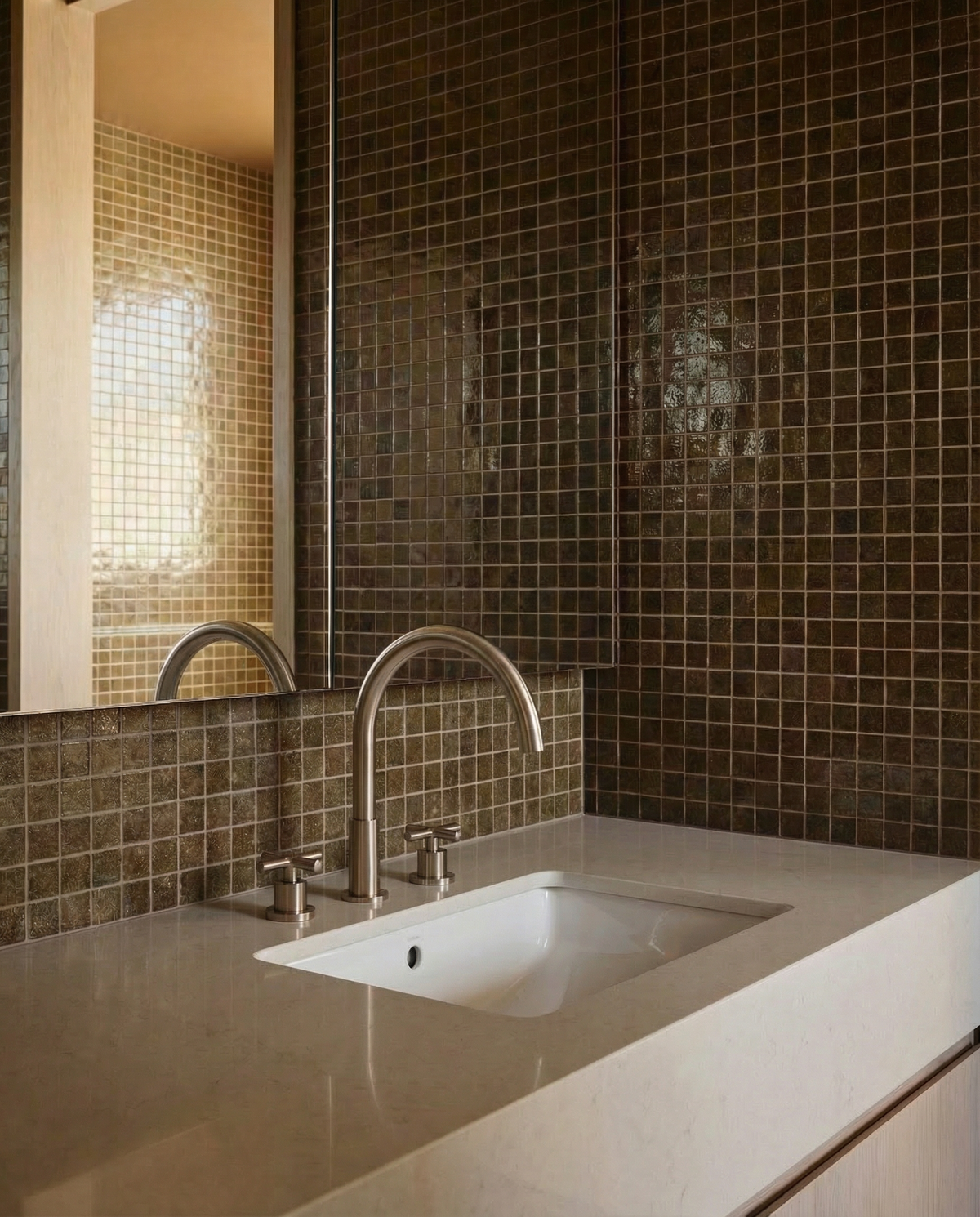
This is the reason that matters most specifically to translucent/clear glass mosaic tile, as opposed to ceramic or stone mosaic. Glass tesserae are frequently translucent or semi-translucent by design - that's part of their appeal, the way light plays through them. Anything glued to the back of a translucent tile has a real chance of showing through once it's grouted and lit.
Mesh is the worst offender here. A grid of fibreglass sitting directly behind a translucent glass tile can visibly discolour it or leave a faint checkerboard shadow across the finished surface, especially under strong or angled lighting. Glue dots are less visually intrusive than a full mesh grid, but the dots themselves can still telegraph through very transparent glass as small pale or dark spots, particularly on lighter, more translucent colourways.
Paper face avoids this entirely, because there is nothing on the back of the tile to show through. What you see once the paper is removed and the tile is set is the glass itself, and only the glass - exactly as it was designed to look.
No sheet lines, no visible grid
Mesh-backed and glue-dot sheets are still, structurally, sheets. Even when installers do everything right, the edges of adjoining sheets and the underlying grid pattern of the mounting material can create faint but visible lines across a large installation - a subtle "seam" every 30 centimetres or so where one sheet meets the next, or a change in how light reflects off tiles that sit fractionally differently within their sheet versus at the joint.
Because paper face has no rigid backing structure holding the tile in a fixed grid, installers have much more control over individual tile placement while the adhesive is still workable. Spacing can be adjusted, tiles can be nudged into alignment with the sheet next to it, and the finished field reads as one continuous surface rather than a collection of tiles pretending to be one. For large walls, feature panels, and anywhere the mosaic needs to look seamless rather than tiled, this matters a great deal.
It's genuinely easier to install well - even though it takes an extra step
We'll be upfront: paper face does add a step that mesh and glue-dot systems don't have. The paper has to be soaked and peeled away after the adhesive sets, usually 20–30 minutes after installation, and any tiles that have drifted out of alignment need to be straightened before grouting.
But that extra step is exactly what gives installers control that the other two systems don't offer. With mesh or glue dots, once a sheet is pressed onto the wall, you're largely committed to the grid it came in - repositioning an individual tile after the adhesive starts to grab is difficult, and forcing it risks breaking the tile's bond to the mesh or snapping a glue dot loose. With paper face, the sheet is genuinely adjustable while the mortar is workable: you can true up a pattern, close a gap, or correct a piece that's sitting proud, and the tile stays properly bedded in adhesive the whole time because nothing is holding it rigidly at a fixed spacing. Many experienced installers who've worked with both consider paper-faced tile easier to get a genuinely flat, well-aligned result from, not harder — the extra step at the end buys real control earlier in the process.
Removal is simpler too. Paper lifts away with water and a sponge. Mesh, by contrast, has become progressively harder to remove over the years as adhesive formulations have improved - which is good news if you never want to touch the tile again, but a real headache if a sheet needs to be adjusted, salvaged for a repair, or reused.
Better hygiene in wet installations
Because paper face leaves no backing material embedded in the finished wall, there's no mesh substrate sitting under the tile that can hold moisture over the long term. In continuously wet environments - showers, pool tiling, splashback areas prone to condensation - a fibreglass mesh trapped between tile and substrate can, over time, become a place for mould or bacteria to establish, particularly if the original bond was ever imperfect and left a void. With nothing back there but tile and thin-set, paper-faced installations don't create that hidden layer in the first place.
Where mesh and glue dots still make sense
We're not here to say mesh and glue-dot backing are always the wrong choice - they exist for good reasons. Glue-dot systems, in particular, are genuinely useful for mosaics going onto curved or irregular surfaces, where an installer needs to see the tile pattern from the front while shaping the sheet around a corner or column. Mesh remains a fast, low-cost, practical option for opaque ceramic or stone mosaics, where none of the see-through issues above apply, and where speed of installation matters more than the finer points of bond quality or seamlessness.
But for glass - translucent, reflective, meant to be looked at rather than just walked on - those trade-offs stop making sense. The properties that make glass mosaic worth choosing in the first place are exactly the properties that mesh and glue dots put at risk.
Our standard
Every glass mosaic sheet we stock at Tiles of Ezra is paper-faced, full stop. It costs us more in manufacturing and asks a little more of the installer on-site, and we think that trade is worth making every time. It's how we make sure the glass bonds properly to the wall, reads as one continuous surface rather than a grid of sheets, and shows nothing but the colour and clarity of the glass itself - which, at the end of the day, is the entire reason anyone chooses glass mosaic over anything else.
If you're installing our tile for the first time and want guidance on adhesive selection, paper-removal timing, or grouting, our team is always happy to talk it through before you start.